Fidelity to the Word
Our Lord and His Holy Apostles at the Last Supper


A blog dedicated to Christ Jesus our Lord and His True Presence in the Holy Mystery of the Eucharist


The Lord Jesus, the same night in which He was betrayed, took bread, and giving thanks, broke, and said: Take ye and eat, this is My Body which shall be delivered for you; this do for the commemoration of Me. In like manner also the chalice.

Tuesday, January 09, 2007

Liturgical Dance

Liturgy? Yes!
Dancing? Yes!

Liturgical dance? No, no, no.


No.

~~~

(Mostly no). I did once attend Mass with a congregation that was 99% Haitian. The people who brought up the gifts swayed to music as they walked forward, and in that context their movements seemed as serious, as joyful, as authentic, as appropriate as a wedding march.

By contrast, any dance that would turn a congregation into an audience observing a performance would be out of place at a Mass.

~~~

Cardinal Francis Arinze, prefect of the Congregation for Divine Worship and the Discipline of the Sacraments, has publicly criticized introducing dance into the Liturgy, as it risks reducing this sacred rite to a spectacle. In an address in 2003, for example, the cardinal responded to a question on "liturgical dance": "There has never been a document from our Congregation for Divine Worship and Discipline of the Sacraments saying that dance is approved in the Mass"; and he noted that "the tradition of the Latin Church has not known the dance. It is something that people are introducing in the last ten years -- or twenty years". (See Cardinal Responds to Questions on Liturgy AB October 2003)

There has not been an express ruling from the Holy See against so-called "liturgical dance" -- primarily because, as Cardinal Arinze also observed, dance-like movements during processions are customary in some countries, and thus may be a legitimate form of "inculturation" of the Litugy in these regions. This kind of ritual dance has been introduced into several papal liturgies in recent years -- on occasions usually connected with African or Asian culture. These are special exceptions, however, that are to be seen in the context of the Holy Father's unique universal role, not as precedent-setting liturgical variations.

But the Holy See has addressed the matter of dance, constantly stressing the proper distinction between permitting indigenous cultural traditions and introducing innovations into the celebration of the Liturgy...

On "Liturgical Dance"

See also: "Liturgical dance smackdown, Benedict style", and Gerald Augustinus's Liturgical Dance Collection

Labels: ,

Sunday, June 11, 2006

Perichoresis

I recently encountered two words that theologians use to describe the unity of the Trinity: from Greek perichoresis and from Latin circumincession. They mean the same thing, that each Person of the Blessed Trinity lives in the other two, and they act with one accord and cannot be separated from each other, yet they remain distinct Persons.

Perichoresis literally means "dancing around", although it has perhaps become a theological term of art divorced from its origins. As an occasional social dancer, I hope it is not irreverent to still see in human dance some dim reflection of the Divine life. My own dancing is typically lead-footed and clumsy, but, once in a great while, the weights fall off, and with Rebecca, my friend and dance partner, we soar. There is joy in dancing as one, a small model of the exaltation and unity of the Ever-Blessed Trinity.

Years ago I read Chance or the Dance by Thomas Howard. As I recall, it contrasted the modern view of the world as a place of random, meaningless events with an older view of the world as a great dance, wherein we each have a part. I am reminded of both views when I think of a folk dance I once attended. From inside the dances, things looked chaotic, with lots of people wheeling around and going under each other's arms (the whirling energy was a big part of the fun). But of course there was a pattern to the dancing, and one only got into trouble when one left the pattern.

With Christ Jesus as our model, we learn our part in the dance of life, moved sometimes by the Holy Spirit, but other times by the zeitgeist or by our own stubborn will. Leaving the pattern, we may step on a few toes. We may even stumble and fall. If we do, the music still goes on, and the master of the dance waits for us to resume our part, training us with infinite patience and tremendous insistence, preparing us for our part in the great eternal dance, where the life and light and joy of the Father, Son and Holy Spirit fill the souls of the blessed.


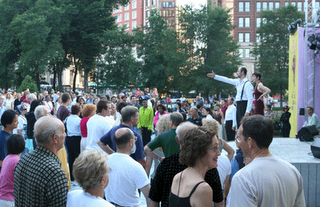
SummerDance LessonBlogger and friend, lower-right foreground, at Chicago's SummerDance


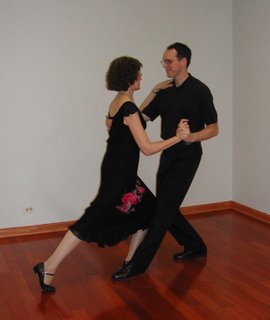
Two to TangoLearning to Tango

+++

The Council of Florence declared:
These three persons are one God, not three gods; for the three persons have one substance, one essence, one nature, one divinity, one immensity, one eternity. And everything is one where there is no distinction by relative opposition. Because of this unity, the Father is entirely in the Son and entirely in the Holy Spirit; the Son is entirely in the Father and entirely in the Holy Spirit; the Holy Spirit is entirely in the Father and entirely in the Son. None of the persons precedes any of the others in eternity, nor does any have greater immensity or greater power. From eternity, without beginning, the Son is from the Father; and from eternity and without beginning, the Holy Spirit has proceeded from the Father and the Son.' All that the Father is, and all that he has, he does not have from another, but of himself; he is the principle that has no principle. All that the Son is, and all that he has, he has from the Father; he is a principle from a principle. All that the Holy Spirit is and all that he has, he has from the Father and equally from the Son. Yet the Father and the Son are not two principles of the Holy Spirit, but one principle, just as the Father and the Son and the Holy Spirit are not three principles of creation, but one principle. Therefore, the holy Roman Church condemns, disapproves, anathematizes, and declares to be separated from the body of Christ, which is the Church, all who hold any contrary opinions.


(Relative opposition, or relation, is the opposition between two terms either of which needs the other to explain it. For example, the ideas of father and son, of double and half, of knowledge and the object known.)

Labels: , , , , ,