Fidelity to the Word
Our Lord and His Holy Apostles at the Last Supper


A blog dedicated to Christ Jesus our Lord and His True Presence in the Holy Mystery of the Eucharist


The Lord Jesus, the same night in which He was betrayed, took bread, and giving thanks, broke, and said: Take ye and eat, this is My Body which shall be delivered for you; this do for the commemoration of Me. In like manner also the chalice.

Wednesday, December 14, 2011

Ember Wednesday

From today's Mass, a collect:

Hasten, we beseech Thee, O Lord, tarry not: and grant us the help of Thy heavenly power, that they who trust in Thy loving kindness may be relieved by the consolations of Thy coming. Who livest and reignest, with God the Father, in the unity of the Holy Ghost, God, through all the ages of ages.

A gradual:

The Lord is nigh unto all them that call upon Him, to all that call upon Him in truth.
V.: My mouth shall speak the praise of the Lord: and let all flesh bless His holy Name.

and the offertory:

Take courage, and now fear not: for behold our God will bring judgment: He Himself will come and will save us.

Labels: , ,

Wednesday, July 13, 2011

A Glimpse at Calvary through the Mass

How can an all-powerful, all-loving God allow innocent suffering? "Reverend Know-it-all" answers this perennial question here. His comments are worth reading in their entirety, and thinking about. They include an account of what I am sure is one of the pivotal moments of his life:

When I was much younger I had been assigned to a very poor parish. The windows were in very bad repair. Summer and winter the wind whistled through the cracks. We might just as well have held services outside.

One summer morning I was saying Mass and the fruit flies were hovering around the chalice. In my mind I said to the Lord, “I believe that this is no longer bread and wine, but has become Your body and blood, but couldn’t You convince the fruit flies of this great miracle for just a moment?”
A little long-suffering (and, I hope, affectionate) complaint from a priest to his Master, I suppose. Certainly, he was not expecting any sort of a reply. To his lasting surprise and edification, however, the young priest received an answer anyway.

Labels: ,

Thursday, June 03, 2010

Saints Marcellinus and Peter

Saint Peter was an exorcist from Rome arrested during the Diocletian persecution. While in jail, he converted Arthemius, his jailer, and the jailer's wife and daughter. He took them to Marcellinus, a prominent priest of the city, who baptised them. All were condemned by the judge Serenus (or Severus).

The two saints were tortured, and taken to woods outside the city where they were forced to dig their own graves and then beheaded. The intent was that the Christian community would not be able to recover and venerate the bodies. But they were not forgotten. The executioner eventually converted, and led pious Christians to the bodies. And he told the martyrs' story to a young boy who became Pope St. Damasus [AD 304 - 384]. As Pope, St. Damasus had details of their martyrdom inscribed in an epitaph on their tomb. The Emperor Constantine I [AD 306 - 337] raised a basilica in their honour over their tombs, and there buried his own mother, St. Helen. During the reign of Charlemagne [AD 747 - 814] their fame spread and they were venerated throughout Italy and Gaul.

They are still remembered in the traditional Mass, together with other great martyrs of the early Church:

Nobis quoque peccatoribus famulis tuis, de multitudine miserationum tuarum sperantibus, partem aliquam, et societatem donare digneris, cum tuis sanctis Apostolis et Martyribus: cum Joanne, Stephano, Matthia, Barnaba, Ignatio, Alexandro, Marcellino, Petro, Felicitate, Perpetua, Agatha, Lucia, Agnete, Caecilia, Anastasia, et omnibus Sanctis tuis: intra quorum nos consortium, non aestimator meriti sed veniae, quaesumus, largitor admitte. Per Christum Dominum nostrum.

To us also, sinners, yet Thy servants, trusting in the greatness of Thy mercy, deign to grant some part and fellowship with Thy holy apostles and martyrs: with John, Stephen, Matthias, Barnabas, Ignatius, Alexander, Marcellinus, Peter, Felicitas, Perpetua, Agatha, Lucy, Agnes, Cecilia, Anastasia, and all Thy saints; into whose company we implore Thee to admit us, not weighing our merits, but freely granting us pardon. Through Christ our Lord.

May their memory be eternal and their reward be great.

(Sources include 1, 2, 3, 4)

Other martyrs are also remembered today. Saint Erasmus, a bishop of Syria, was killed about the same time and became widely revered as one of the Fourteen Holy Helpers. In an earlier persecution under Marcus Aurelius in AD 177, the Martyrs of Lyons and Vienne (Saint Pothinus, Saint Sanctus, Saint Marturus, Saint Attalus, and Saint Blandina, and others whose names are remembered by God) were falsely accused of cannibalism and other abominations, and brutalized and murdered in the arena. May they rest in peace and arise in glory.

Labels: ,

Saturday, March 06, 2010

Saints Felicity and Perpetua

Saints Felicity and Perpetua are invoked in the Nobis quoque peccatoribus of the traditional Mass and optionally in Eucharistic Prayer I of the new Mass. Their feast day is today in the old calendar and tomorrow in the new.

Saint Felicity was seven months pregnant and Saint Perpetua was still nursing her infant when they were arrested with three men on suspicion of conversion to Christianity. In the pagan Roman empire of their day (203 AD), as in some predominantly Muslim countries today, the presence of Christianity was barely tolerated and conversion was punishable by death.

Felicity was the slave of Perpetua, but the two are said to have been more like sisters than slave and mistress: in Christ there is neither slave nor freeman (Colossians 3:11, Galatians 3:28). A few days after their arrest, the five were baptised. Shortly after, they were moved from the private house where they were initially held to prison. There they were joined by their instructor Saturus, who was unwilling to abandon them in their time of suffering. (Saturus may have been the brother of Saturninus, one of the arrested catechumens).

Perpetua left a written record of her last days: the dark and crowding of the prison, her anxiety for her infant son, her pagan father's anxiety for her, and his desperate attempts to get her to recant and offer sacrifice for the emperor. She also recorded consoling visions sent to her by God. It is the earliest known writing from a Christian woman.

While in prison, Felicity delivered her baby, whom a Christian woman adopted, and one of the men, Secundulus, died. The rest were sentenced to be exposed to wild beasts. On March 7, AD 203, they were brought to the arena, and there died, encouraging each other to remain steadfast, exhorting a soldier who had shown them kindness to have faith, and warning the procurator that he faced judgment from God.

(The words of Saint Perpetua, together with a vision of Saint Saturus and the record of a witness to their martyrdom, are available in translation on several sites on the internet, for example here).

Sanctæ Perpetua et Felicitas

"And now, dear saints, Perpetua and Felicitas, intercede for us during this season of grace. Go with your palms in your hands, to the throne of God, and beseech Him to pour down His mercy upon us. It is true, the days of paganism are gone by; and there are no persecutors clamoring for our blood. You, and countless other martyrs have won victory for faith; and that faith is now ours; we are Christians. But there is a second paganism, which has taken deep root among us. It is the source of that corruption which now pervades every rank of society, and its own two sources are indifference, which chills the heart, and sensuality, which induces cowardice. Holy martyrs! pray for us that we may profit by the example of your virtues, and that the thoughts of your heroic devotedness may urge us to be courageous in the sacrifices which God claims at our hands. Pray, too, for the Churches which are now being established on that very spot of Africa, which was the scene of your glorious martyrdom: bless them, and obtain for them, by your powerful intercession, firmness of faith and purity of morals."

(From Volume 4 of The Liturgical Year by Dom Prosper Guéranger of happy memory).

Labels: , , ,

Monday, February 22, 2010

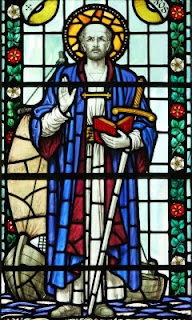
The Holy Apostle Peter

"Blessed art thou, Simon Bar-Jona: because flesh and blood hath not revealed it to thee, but my Father who is in heaven. And I say to thee: That thou art Peter [in Aramaic, Kepha, which means rock], and upon this rock [Kepha] I will build my church, and the gates of hell shall not prevail against it. And I will give to thee the keys of the kingdom of heaven. And whatsoever thou shalt bind upon earth, it shall be bound also in heaven: and whatsoever thou shalt loose on earth, it shall be loosed also in heaven".
[Matthew 16:17-19]

Even today, some people have trouble believing our Lord's own words that He would build His church on St. Peter. Peter? Impulsive to the point of rashness [John 18:10], alternately weak[Matthew 26:72], prideful[Mark 9:33] and confused[Mark 9:4] Peter? Peter, who was rebuked so many times by our Lord[Matthew 16:23]?1

The Lord chastises those whom he loves [Hebrews 12:6]. His loving corrections prepared St. Peter to shepherd His flock. It is often said that grace builds on nature. I think that is why our Lord chose St. Peter: the same characteristics that tended to get Simon Peter into trouble also allowed him to follow Christ whole-heartedly, and in time to preach the good news to a hostile world. Jesus did not build his Church on a timid man. (Or men. Most of the twelve died martyrs).

Peter trusted our Lord so thoroughly that perhaps even before he was Saint Peter, he was ready to walk on water at Jesus' command. After a few steps, he became frightened and began to sink. Our Lord chided him for his lack of faith, but I don't think anyone else is in a position to do so, unless he can stand with them on the water amid the waves and not sink.

St Peter goes for a walk

Our Lord raises up the lowly [1 Samuel 2:8] and in the weakness of men manifests His strength [2 Corinthians 12:9]. He took a poor, uneducated fisherman from Galilee and over a period of years made him a holy man, a saint capable of miracles, the leader of the apostles after the Ascension.

St. Peter led the apostles in choosing a replacement for Judas Iscariot[Acts 1]. He was the first to speak to the multitude that gathered at the descent of the Holy Spirit at Pentecost[Acts 2]. He was the first Apostle to perform a miracle in the name of the Lord[Acts 3]. Filled with the Holy Spirit, he preached the good news to all the nation, even to the Sadducees who opposed him[Acts 4]. St. Peter pronounced Divine judgment upon the deceitful Ananias and Sapphira[Acts 5]. He traveled through Judea, Galilee and Samaria building up the Church[Acts 9]. He baptized Cornelius, the first gentile convert[Acts 10] and made the inclusion of gentiles in the Church acceptable[11:1-18]. An angel delivered him from imprisonment by King Herod Agrippa[Acts 12]. After his escape, he sent word to James and the other brethren who remained in Jerusalem, eventually returning there himself. There he spoke the deciding word against requiring gentile converts to observe Mosaic law[Acts 15]. He did not stay in Jerusalem. In subsequent missionary work, he spent some years building up the church in Antioch, he visited Corinth, and eventually he came to Rome. During the reign of the Roman emperor Nero, St. Peter was captured and sentenced to crucifixion. He did not deem himself worthy to die in the same way as his master. At his request, he was crucified upside-down.

St. Peter wrote two epistles which are recognized as Divinely-inspired and are part of the New Testament.

In all his labors he obeyed our Lord's commands to him to "feed my sheep" [John 21:15-17]) and to "strengthen thy brethren" [Luke 22:32].

Both eastern and western Catholics honor St. Peter and St. Paul on the 29th of June every year. St. Peter is also remembered by traditional Roman Catholics today (the Chair of St. Peter) and on November 18th (the Dedication of the Basilicas of Sts. Peter and Paul). Prior to 1960 we also honored him on August 1st (St. Peter's Chains). He had a feast day on the 18th of January which is now observed as the start of the Octave of Christian Unity.

1 Some insist that our Lord must have been referring to Peter's faith, or to the words Peter just spoke, or even that He switches in mid-sentence from speaking about Peter to speaking about Himself (and then back to St. Peter again in the next couple sentences). All these interpretations strain against the obvious play on words in Matthew 16, as even some protestant scholars recognize, especially in the context of our Lord giving St. Peter the keys of the kingdom of heaven. Even if our Lord had referred to Himself as the rock on which He would build His church, in the same breath using the same image for St. Peter would have only reinforced the message that St. Peter would truly be his chosen representative.

Some who wish to minimize the authority of St. Peter and his successors are fond of quoting St. Augustine's opinion later in life that it was Peter's confession of faith that was "the rock", not Peter himself. (Earlier in life St. Augustine said that St. Peter was the rock on which Christ built his Church. Peter means "rock"). But in that same quote, St. Augustine went on to say that Peter was the representative person for all the Church. Those who have separated themselves from Peter have separated themselves from the symbol of the unity of the mystical body of Christ.

Laus tibi, Domine, Rex æterne gloriæ.

Papal Flag

Labels: , ,

Tuesday, February 16, 2010

The Holy Apostle Paul

I wonder what Rabbi Gamaliel thought of his student Saul (better known to us as St. Paul). Gamaliel was a moderating force in the Sanhedrin; he argued for lenient treatment of Christians.

Many believe that Saul was also a member of the Sanhedrin. He was certainly not a moderating force there: when the first Christian martyr died, Saul held the coats of the men doing the stoning and approved what they did.

Saul continued to persecute the Church, arresting some and scattering others. (St. Philip the Deacon is one who evaded Saul. He traveled first north to Samaria and then west to Gaza, making converts, notably Simon Magus and the Ethiopian eunuch).

Saul was on the road to Damascus to persecute the Church there, when our Lord intervened, blinding him, rebuking him, then sending Ananias, the bishop of Damascus, to heal and baptize him. In Damascus, Saul began speaking out on behalf of the Church instead of against it.

He soon withdrew to Arabia, perhaps to meditate on the Scriptures and on the revelation he had personally received, and to understand and prepare for the new life to which the Lord was calling him.

After three years he returned to Damascus, began preaching the gospel again, and was soon forced to flee by the offended Jews of that city. He went to Jerusalem to visit Saint Peter, and there was met with distrust, because of his history, until Saint Barnabas vouched for him. In Jerusalem he again preached the gospel, and again antagonized the local Jewish population (specifically the Hellenized Jews). They plotted his murder, so leaving Jerusalem he returned to his native Tarsus and is lost to history for the next few years.

While Paul was in Tarsus, the followers of Christ that had been dispersed by persecutions spoke to Jew and gentile, converting many. Saint Barnabas was sent to support the new Church in Antioch; he sought out Paul, and together the two of them built up the Church there. It was in Antioch that the followers of Christ were first named Christians.

Antioch became the base from which Saint Paul set out on the great journeys of evangelization recorded in Holy Scripture. The Catholic Encyclopedia divides his travels into "three great Apostolic expeditions of which Antioch was in each instance the starting-point and which invariably ended in a visit to Jerusalem."

When the Book of Acts ends, St. Paul is still in the midst of his labors. He is believed to have travelled as far west as Spain to preach the Good News.

He ended his days in Rome, around the mid-60s AD, during the persecution by Emperor Nero. The Cistercian Abbey of Tre Fontane is located on the site of his beheading.

Saint Paul is invoked and honored with St. Peter in the Confiteor, in the prayer to the Most Holy Trinity, in the Communicantes, in the Libera nos, and in the Leonine prayers recited after Low Mass. He is remembered every June 29th together with the first Pope, Saint Peter, who was also martyred in Rome.

Labels: , ,

Thursday, February 11, 2010

Blessed John the Baptist

Behold, I will send my messenger, and he shall prepare the way before me: and the Lord, whom ye seek, shall suddenly come to his temple, even the messenger of the covenant, whom ye delight in: behold, he shall come, saith the LORD of hosts. (Malachi 3:1)

Saint John the Baptist was the last of the Old Testament prophets and was sanctified to God from before his birth. (Luke 1:15, Luke 1:41). Jesus said of him that "there hath not risen among them that are born of women a greater than John the Baptist" (Matthew 11:11), and that he was "a burning and a shining light" (John 5:35). St. John was an ascetic, earnest and fearless in preaching the need for people to repent of their sins. The selfless integrity of his personal life and the power of his preaching was such that he attracted crowds, and some wondered if he himself was the messiah for whom they waited.

John answered all of them by saying, ‘I baptize you with water; but one who is more powerful than I is coming; I am not worthy to untie the thong of his sandals. He will baptize you with the Holy Spirit and fire. His winnowing-fork is in his hand, to clear his threshing-floor and to gather the wheat into his granary; but the chaff he will burn with unquenchable fire.’ So, with many other exhortations, he proclaimed the good news to the people. (Luke 3:16-18)

When St. John rebuked Herod the tetrarch for his sins, Herod cast him into prison and later beheaded him at the urging of Herodias, whom he had illicitly married, and her daughter.

Before St. John was conceived, his parents were already old and had little hope of having a child. But God heard their prayers and gave them a son. The angel Gabriel announced that his name would be John, which means "God is merciful". St. John prepared Israel to receive God's mercy by "preaching the baptism of penance for the remission of sins" (Luke 3:3).

If his baptism was a sign of repentance, then why did our Lord, who was not guilty of any sin, came to the Jordan river to be baptized by John? Some have pointed out that the Kings of the house of David were anointed by Levite priests. John the Baptist was a Levite of the priestly line of Aaron. In baptizing Jesus, he was anointing Him at the start of His public ministry. (The word "Messiah" means "Anointed One"). St. Thomas, in his Catena Aurea (Matthew, Mark) and Summa Theologica offers other explanations, including that Jesus was providing a model of humility for us, leading us to baptism, and asking no more of us than He did himself, and that in His baptism, He purified the waters, rather than being purified by them, in preparation for the greater baptism that was to follow. As our Lord came out of the waters, the whole Holy Trinity was manifested together, the Son in the flesh, and the Father in a voice from Heaven, and the Holy Spirit in the form of a dove.

Baptism of Christ

Venerable Bede said that this event was a sign of the grace given to us in Baptism. In Baptism, we receive the gift of the Holy Spirit and by adoption are made sons of God.

John is the third saint addressed in the confiteor and first martyr mentioned in the Nobis quoque peccatoribus.

Both the birth and the death of the Forerunner are remembered by the Roman Catholic Church by two separate feast days:
  • June 24 – Nativity of St. John the Baptist
  • August 29 – Beheading of St. John the Baptist
Nearly all other saints are remembered only on the day that they fell asleep in the Lord. But St. John was holy all his life, so his birth is celebrated, too. Also, poetry links his birth, six months before our Lord's, to the shortening of days that begins in mid-summer and St. John's own words: "He must increase, I must decrease".

(Offered on the commemoration of the apparition of the Immaculate Virgin Mary at Lourdes. Blessed be God in His angels and His saints).

Labels: , , ,

Monday, February 08, 2010

Blessed Michael the Archangel

 
Sancte Michael ora pro nobisThe great guardian angel of the Church, St. Michael is the second saint mentioned in the Ordinary of the Mass (in the Confiteor). His name in Hebrew means "Who is like God?", the reply and war-cry of the good angels to Satan, who rebelled against God. St. John in his Apocalypse, chapter 12, recounts that St. Michael lead the good angels in battle against the devil and his followers and drove them from heaven.

In Daniel, chapter 12, Michael is called "the great prince who standeth for the children of Thy people." In chapter 10, another angel (probably St. Gabriel) says that St. Michael contends for Israel. He may have also appeared to Joshua before the fall of Jericho.

St. Michael is revered in both the Old and New Testament as the protector of the people of God. Wikipedia lists rabbinic traditions concerning St. Michael, including that he taught Moses, and disputed with the devil over the soul of Moses. Perhaps this relates to a statement in the Letter of St. Jude that St. Michael disputed with the devil about the body of Moses.

Both Christian and mystical Jewish tradition depicts St. Michael assisting the souls of the pious in their entry into the heavenly Jerusalem. He is sometimes depicted carrying a set of scales, because he escorts souls to judgment. For the same reason he is also (more rarely) depicted holding the book of life, or next to a body, holding a baby (the soul newly born to the next life).

Even more than as a patron in military conflicts, in the early Church, especially in Asia Minor, St. Michael was invoked as a healer. Curative springs were dedicated to him -- I wonder whether he was considered the angel mentioned in John 5:4?

So he is the special patron of sick people; also of policemen and paratroopers. Someone with a sense of humor decided that since he is depicted with a a set of scales, he should be the patron of grocers. He is the patron of various nations, cities and shrines. From being the patron of a sea-side shrine, he became the patron of mariners.

It might seem that all the prayers from all the people devoted to him would be too much for any creature to handle, but St. Michael is one of the bodiless Powers of Heaven, dwelling with God, not limited by time as we would be here on Earth. "With loving solicitude and princely bearing," he intercedes for us, and with our guardian angels at the end of our days, "he presents us to the Light Eternal and introduces us into the House of God's glory." [adopted from Dom Prosper Guéranger, The Liturgical Year, Volume VIII]

Charity should flow in two directions. Here is a parish dedicated to St. Michael. Here is a lay Catholic organization dedicated to St. Michael. Various saints in their earthly life were devoted to St. Michael, including St. Francis of Assisi, St. Bernard of Clairvaux, and St. Joan of Arc.

Pope Leo XIII's Prayer to St. Michael

Pope Leo XIII approved this prayer to St. Michael in 1888. Some Catholics believe that this is the original version of the prayer to St. Michael said after low Masses, but this belief appears to be erroneous. Pope Leo mandated that the shorter, more familiar prayer be said after Masses in 1886. This prayer was composed for use outside of Mass:

O Glorious Prince of the heavenly host, St. Michael the Archangel, defend us in the battle and in the terrible warfare that we are waging against the principalities and powers, against the rulers of this world of darkness, against the evil spirits. Come to the aid of man, whom Almighty God created immortal, made in His own image and likeness, and redeemed at a great price from the tyranny of Satan

Fight this day the battle of the Lord, together with the holy angels, as already thou hast fought the leader of the proud angels, Lucifer, and his apostate host, who were powerless to resist thee, nor was there place for them any longer in Heaven. That cruel, ancient serpent, who is called the devil or Satan who seduces the whole world, was cast into the abyss with his angels. Behold, this primeval enemy and slayer of men has taken courage. Transformed into an angel of light, he wanders about with all the multitude of wicked spirits, invading the earth in order to blot out the name of God and of His Christ, to seize upon, slay and cast into eternal perdition souls destined for the crown of eternal glory. This wicked dragon pours out, as a most impure flood, the venom of his malice on men of depraved mind and corrupt heart, the spirit of lying, of impiety, of blasphemy, and the pestilent breath of impurity, and of every vice and iniquity.

These most crafty enemies have filled and inebriated with gall and bitterness the Church, the spouse of the immaculate Lamb, and have laid impious hands on her most sacred possessions. In the Holy Place itself, where the See of Holy Peter and the Chair of Truth has been set up as the light of the world, they have raised the throne of their abominable impiety, with the iniquitous design that when the Pastor has been struck, the sheep may be.

Arise then, O invincible Prince, bring help against the attacks of the lost spirits to the people of God, and give them the victory. They venerate thee as their protector and patron; in thee holy Church glories as her defense against the malicious power of hell; to thee has God entrusted the souls of men to be established in heavenly beatitude. Oh, pray to the God of peace that He may put Satan under our feet, so far conquered that he may no longer be able to hold men in captivity and harm the Church. Offer our prayers in the sight of the Most High, so that they may quickly find mercy in the sight of the Lord; and vanquishing the dragon, the ancient serpent, who is the devil and Satan, do thou again make him captive in the abyss, that he may no longer seduce the nations. Amen.

V. Behold the Cross of the Lord; be scattered ye hostile powers.
R. The Lion of the tribe of Judah has conquered the root of David.
V. Let Thy mercies be upon us, O Lord.
R. As we have hoped in Thee.
V. O Lord, hear my prayer.
R. And let my cry come unto Thee.

Let us pray.

O God, the Father of our Lord Jesus Christ, we call upon Thy holy Name, and as supplicants, we implore Thy clemency, that by the intercession of Mary, ever Virgin Immaculate and our Mother, and of the glorious St. Michael the Archangel, Thou wouldst deign to help us against Satan and all the other unclean spirits who wander about the world for the injury of the human race and the ruin of souls. Amen.

Labels: , , ,

Friday, February 05, 2010

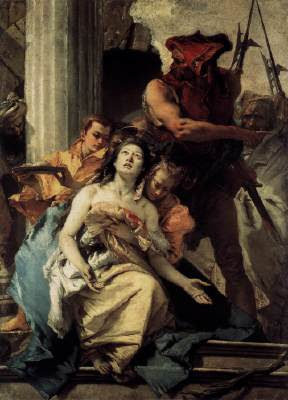
Saint Agatha , Virgin and Martyr

Today is the feast of Saint Agatha, who was martyred in 251 in Catania, Sicily. She died about a half-century before Saint Agnes and slightly precedes her in the Nobis quoque peccatoribus of the Traditional Mass. Even more than Saint Agnes, little is known with certitude about today's saint, beyond the fact of her martyrdom and her veneration by the early Church.

The story of the two saints is similar. Saint Agatha was a bit older, in her mid-teens or early 20s, with a reputation for great beauty. She attracted the attention of a Roman official in Sicily during the time of the Decian persecution. When she refused his advances, he delivered her to a pagan woman named Aphrodisia, who for a month tried to persuade Agatha to apostatize, with promises of a life of ease of she would yield and warnings of grievous torments if she would not. When Aphrodisia concluded that she would not be able to persuade Agatha, the Roman official (Quintianus) put her in prison, and tried to coerce her into submitting using the anti-Christian laws then in effect, and then tortured more viciously when she still refused, until finally she died in the midst of her torments. She is sometimes depicted in art with her breasts cut off.

By some accounts St. Peter appeared to her with an angel during her torments to heal and comfort her. St. Agatha in turn is said to have interceded for Christians in later centuries, a demonstration of the bond of charity that unites the body of Christ from generation to generation. Her merits and prayers are credited with quieting Mount Aetna when it threatened to erupt, and with saving Malta from invasion by Turkey.

In addition to being remembered in the Mass, Pope Pius XI honored her in 1934 by making her church in Rome a Stational church (Third Tuesday in Lent).

Saint Agatha
My fellow Christians, our annual celebration of a martyr’s feast has brought us together. Agatha achieved renown in the early Church for her noble victory. ...For her, Christ’s death was recent, his blood was still moist. Her robe is the mark of her faithful witness to Christ. ...Agatha, the name of our saint, means “good.” She was truly good, for she lived as a child of God. ...Agatha, her goodness coincides with her name and her way of life. She won a good name by her noble deeds, and by her name she points to the nobility of those deeds. Agatha, her mere name wins all men over to her company. She teaches them by her example to hasten with her to the true Good, God alone.
- from a homily on Saint Agatha by Saint Methodius of Sicily

Labels: , ,

Sunday, January 31, 2010

Before All Other Saints


Blessed Virgin Mary

The Virgin

Mother! whose virgin bosom was uncrost
With the least shade of thought to sin allied;
Woman! above all women glorified,
Our tainted nature's solitary boast;
Purer than foam on central ocean tost;
Brighter than eastern skies at daybreak strewn
With fancied roses, than the unblemished moon
Before her wane begins on heaven's blue coast;
Thy Image falls to earth. Yet some, I ween,
Not unforgiven the suppliant knee might bend,
As to a visible Power, in which did blend
All that was mixed and reconciled in Thee
Of mother's love with maiden purity,
Of high with low, celestial with terrene!
- William Wordsworth, 1821

First among all the saints, the most honored of God's creatures, is Mary, the ever-virgin mother of our Savior. All generations call her blessed. From all women, God chose her to be the mother of His only-begotten Son. The Lord of all blessed her greatly and sanctified her, and by virtue of the graces bestowed on her, she remained free from all taint of sin throughout her earthly life.

In this He fulfilled the promise of Genesis 3:15, which is called called the protoevangelium, or "first gospel". In that verse, the Lord says to the serpent, the deceiver, "I will put enmity between you and the woman, and between your offspring and hers; He will crush your head, while you strike at His heel." In always choosing to do good and reject evil, our Lady showed unwavering enmity toward the serpent. She showed that it is possible for human beings, by the grace of God, to be free from all bondage to sin. She showed us that it is in fact, possible, to follow our Lord's command to be perfect as our heavenly father is perfect. (Matthew 5:48)

Pope John Paul II said that Mary, the new Eve, is "our Mother according to the Spirit". If we sincerely ask her for help, then as a good and loving mother, she is certain to aid us with her prayers, so that like her, we, too, may be the good and holy people we were made to be.

We have good reasons to believe that our Lord will listen to the prayers of His mother. One is that He performed His first public miracle in response to her intercession. Few of her words are recorded in the Gospels, all are weighted with significance. Her last recorded words are associated with that first miracle: "Do whatever He tells you" (John 2:5).

From the obscurity and poverty of her earthly life, at the end of her days, God lifted her to heaven, where “She stands at His right as a real Queen, with much boldness, clad in golden garments, attired in embroidery, according to the prophetic saying. Yea, she [stands at] the royal throne glittering as the glorious Queen of heaven and earth, and shining inside and outside with the lightings of the gifts of the Holy Spirit, as the ever-illuminating Bride and Mother of the heavenly King of Glory, Jesus Christ, our God and Saviour . . . she stands at the right side of the Son, embroidered in the virtues and gifts of purity, of holiness, everything beautiful, chosen, innocent, as the holiest of saints, noblest of the cherubim, and incomparably more glorious than the seraphim and all the heavenly hosts, being thus, next to God, venerated, glorified, and praised above all beings in heaven and earth.”
—St. John of Damascus

Holy Mary, Mother of God, pray for us.

ween = 'to think; suppose; imagine' or 'to expect; hope; intend'

Offered in honor of Our Lady on Septuagesima Sunday, AD 2010.

Labels: , ,

Thursday, January 28, 2010

Octave of St. Agnes

" Now it came to pass, that while the parents of blessed Agnes were spending the night at her tomb, suddenly in the dead silence of night, a bright light shone forth, and they saw an array of virgins passing, all robed in cloth of gold ; and among them they saw also most blessed Agnes, robed like the rest, and at her right hand there stood a lamb whiter than snow. Her parents and all with them, seeing these things, were silent with wonder. But blessed Agnes said to her parents : Do not grieve for me as dead : but rejoice and be glad, because I have gained the mansions of light, as these have done before me, and am united to Him in heaven, whom while on earth I used to love with my whole soul. This said, she passed away.''
- St. Ambrose (AD 340-397)

Saint Agnes (+ 304) is highly honored in traditional Roman calendar, having two feast days. The first was last week, on the 21st. The second is today. St. Agnes was martyred for her faith at a young age, a week before her 13th birthday. Her parents, and others with them, spent the evening of her birthday at her tomb, and there received the vision mentioned above, which is commemorated on this day.

Many other saints besides St. Ambrose have honored the purity and steadfast faith of St. Agnes. Pope Saint Damasus I, who was born about a year after the death of St. Agnes, became Pope at a time when it was no longer so dangerous to be a Christian. He wrote an epitaph for her which was carved in marble and used to mark her tomb, "but through the ages it was lost. Amazingly, it was at last rediscovered in 1728 inside [her] basilica, whole and complete: it had been used upside down, fortunately as a paving stone!" (Fr. Zuhlsdorf).

In the century following her death, Saint Martin of Tours(316-397), Saint Jerome(340-420) and Saint Augustine(354-430) sang her praises. In years after that, Saint Maximus of Turin (+470), Saint Radbod(+918), Saint Peter Damian (+1071), Saint Gertrude (+1334), Saint Birgitta (+1373) and Pope Saint Pius V(+1572) imitated the earlier saints' example of honoring St. Agnes, before following them into glory.

She is invoked with other martyrs in the Nobis quoque peccatoribus shortly before the Pater noster in the traditional Mass. I used to hear her name regularly even in the new Mass at our parish in the 1970's, but not any more. Despite being so honored, I hardly knew anything about St. Agnes until last week. In order to better honor the saints whom we venerate in the TLM, I hope to read and write a little about each one mentioned in the Ordinary.

"O Saint Agnes, thou who dost follow the Lamb in thy delicate beauty, who dost exult in being a captive in the bonds of His love, in having received the sweet pledge of His faithfulness, and in being brought into His secret chamber, obtain for me that I may be inflamed like Thee with love of Jesus, my Spouse."
- Saint Gertrude (+1334)

Labels: , , ,